
Published: 2026-10-28 | Last Updated: 2026-10-28
Cushioning gets added to a hydraulic cylinder design more often out of habit than genuine analysis — it appears on a previous similar design, so it carries forward to the new one without anyone actually checking whether this application’s stroke speed and end-of-stroke impact conditions justify the added cost and complexity. Sometimes cushioning is genuinely necessary and skipping it causes real problems. Just as often, it’s an unnecessary feature inherited from a design that needed it for reasons that don’t actually apply here. Untangling habit from genuine requirement means going back to the actual physics of the specific application rather than trusting what a previous drawing happened to include.
What Cushioning Actually Does and Why It Costs What It Costs
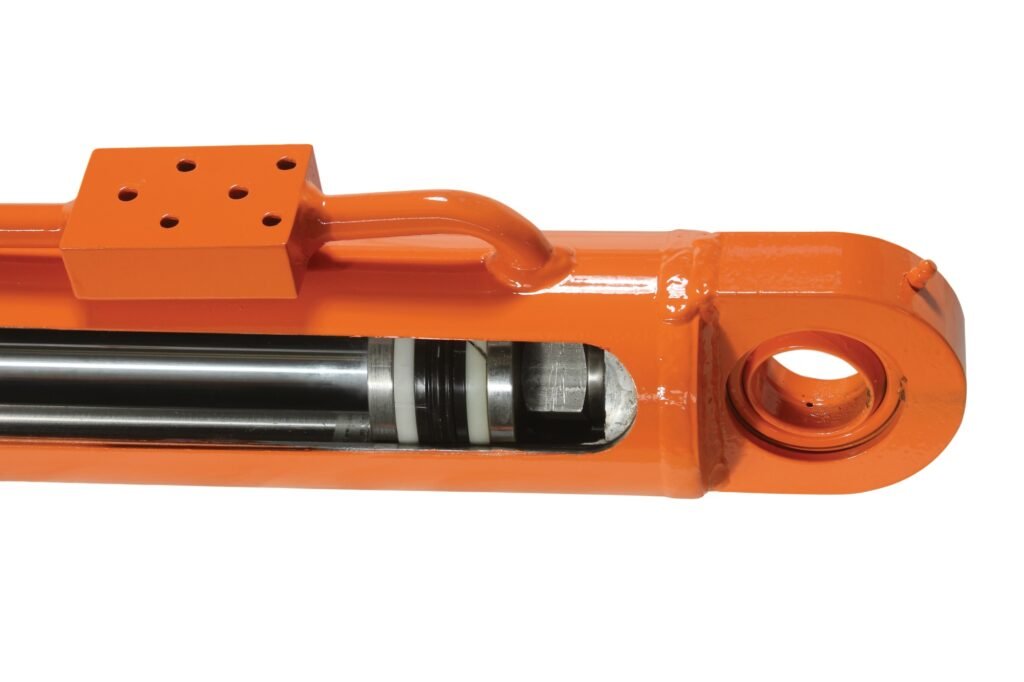
A cushioning feature decelerates the piston gradually as it approaches the end of its stroke, rather than allowing it to strike the end cap at full velocity, by restricting fluid flow through a tapered or metered passage near the stroke limit. This meaningfully reduces impact stress on the end cap, piston, and mounting structure for applications with genuine high-velocity, high-mass end-of-stroke conditions. It also adds machining complexity, a small amount of additional length to the cylinder, and a real cost premium — none of which is justified if the application’s actual stroke speed and piston mass don’t generate meaningful impact energy at the end of stroke in the first place. Two cylinders that look identical on an outline drawing can carry substantially different manufacturing costs purely based on whether this one feature was specified or omitted.
The Actual Calculation That Determines Whether Cushioning Is Needed
Whether cushioning is genuinely necessary comes down to the kinetic energy the piston and attached load carry as they approach end-of-stroke, which depends on mass and velocity squared — meaning stroke speed matters considerably more than most engineers intuitively weight it, since doubling velocity quadruples the kinetic energy that cushioning would need to absorb. Calculating actual end-of-stroke kinetic energy for the specific application — not estimating it qualitatively as “fast” or “slow” — and comparing that figure against the uncushioned impact tolerance of the end cap and mounting structure is the only way to answer this question with real confidence, rather than defaulting to cushioning because a previous, possibly unrelated design included it. This calculation takes an engineer with the right background a short amount of time to complete properly, which makes the ongoing practice of skipping it in favor of habit genuinely difficult to justify on cost grounds alone.
Why Low-Speed Applications Often Don’t Need Cushioning At All
Many hydraulic cylinder applications operate at genuinely low stroke speeds — slow-moving positioning equipment, low-cycle actuators, applications where flow rate is already restricted for reasons unrelated to end-of-stroke impact — and for these applications, the kinetic energy at end of stroke is low enough that a standard end cap design handles repeated full-stroke cycling without any measurable wear or damage over the equipment’s full service life. Carrying forward a cushioning feature into this kind of low-speed application adds cost and complexity that delivers no actual functional benefit, since the feature exists to solve a problem the application was never going to experience in the first place. Recognizing this pattern early in a design review, before the specification propagates into tooling and a production run, is considerably easier than removing an unnecessary feature from an already-established product line later.
When Partial or Adjustable Cushioning Makes More Sense Than Full Cushioning
For applications that operate across a range of speeds or load conditions — sometimes running fast and light, sometimes slow and heavy — a fixed, non-adjustable cushioning design calibrated for one specific operating condition may actually perform poorly across the rest of the application’s operating range, either providing too much deceleration at low speed (unnecessarily slowing the cycle) or too little at high speed (failing to protect against the worst-case impact condition). An adjustable cushioning design, allowing the deceleration profile to be tuned for the actual range of conditions the equipment experiences, costs more than a fixed design but avoids this mismatch — and is worth the added cost specifically for applications with genuinely variable operating conditions rather than a single, consistent duty cycle. Identifying which category a given application actually falls into, rather than assuming a single fixed cushioning design will serve equally well across the full range of its operating conditions, is itself a necessary step most designs skip.
How Mounting Structure Rigidity Changes the Cushioning Decision
The same end-of-stroke kinetic energy that might be entirely tolerable for a cylinder mounted to a rigid, heavy structural frame can cause real problems for an identical cylinder mounted to a lighter, more flexible structure that absorbs and transmits impact energy differently. Evaluating cushioning need in isolation from the actual mounting structure the cylinder attaches to misses half of the relevant physics — the same cylinder design can genuinely need cushioning in one mounting configuration and not need it at all in a different, more rigid configuration, which is one more reason a generic, carried-forward cushioning specification doesn’t reliably transfer from one application to a superficially similar but structurally different one.

What Happens When Cushioning Is Skipped on an Application That Actually Needed It
Skipping cushioning on an application with genuine high-velocity, high-mass end-of-stroke conditions typically shows up as accelerated wear at the end cap and piston seal interface, eventual mounting bolt loosening from repeated impact loading, and in more severe cases, visible cracking or deformation at the end cap over an extended service period. These failure modes tend to develop gradually rather than causing an immediate obvious failure, which means an under-specified cylinder can operate seemingly acceptably for a period before cumulative impact damage eventually produces a field failure — making the original specification decision easy to overlook as the actual root cause once a failure does eventually occur.
How to Audit an Existing Design That Inherited Cushioning Without Justification
For an equipment manufacturer reviewing an existing product line, a worthwhile exercise is pulling the original design rationale for cushioning on each cylinder specification still in production and checking whether that rationale was based on an actual kinetic energy calculation for that specific application, or simply carried forward from an earlier, related design without independent verification. Finding that a cushioning specification traces back to an inherited assumption rather than a calculated requirement doesn’t necessarily mean it should be removed immediately — but it does mean the specification deserves a fresh look, particularly if cost reduction or design simplification is already a stated goal for that product line. This kind of retrospective audit often surfaces one or two legacy over-specifications that have been quietly adding unnecessary cost across every unit produced for years without anyone revisiting the original justification.
Why Field Data From Existing Units Provides the Most Convincing Evidence Either Way
For a product already in field service, examining actual end cap wear patterns and any reported impact-related failures across the installed base provides more convincing evidence about whether cushioning is genuinely needed than any theoretical calculation alone, since field data captures the real operating conditions equipment actually experiences rather than the conditions assumed during original design. A product line showing zero end-of-stroke wear or impact-related complaints across years of field service on uncushioned units is strong evidence that cushioning was never actually necessary for that application — conversely, a product line showing a pattern of end cap wear or mounting fatigue is strong evidence pointing the other direction. This kind of field evidence review is a valuable complement to the theoretical kinetic energy calculation, particularly for borderline cases where the calculation alone leaves some genuine uncertainty.
Why Customer-Facing Durability Claims Sometimes Drive Over-Specification
Equipment manufacturers marketing a product on durability and long service life sometimes default to including cushioning as a defensive measure against warranty risk, reasoning that the added cost is cheap insurance against an unlikely but costly warranty claim, even when the underlying kinetic energy calculation doesn’t clearly justify it. This is a legitimate business decision in some cases — the cost of being wrong in the direction of under-specification can be disproportionately expensive for a manufacturer with strong warranty commitments — but it’s worth recognizing explicitly as a business risk management decision rather than a pure engineering requirement, since conflating the two can lead to over-specifying every design uniformly rather than making a deliberate, application-specific trade-off between added cost and warranty risk reduction.
A Practical Decision Framework for New Cylinder Designs Going Forward
For a new cylinder specification being developed from scratch, a simple decision framework avoids both the trap of defaulting to cushioning out of habit and the opposite trap of skipping it without proper analysis: calculate actual end-of-stroke kinetic energy for the specific stroke speed and load, compare that figure against the uncushioned impact tolerance of the planned end cap and mounting design, and only specify cushioning when the calculated energy genuinely exceeds that tolerance with a reasonable safety margin. Documenting this calculation as part of the design record — not just the final cushioning decision, but the actual numbers and assumptions behind it — gives future designers working on related applications a defensible basis for either reusing or deliberately deviating from the original decision, rather than blindly inheriting a specification whose original justification has been lost to institutional memory.
Related Reading
- Clevis, Trunnion, or Flange: The Mounting Style Decision That Gets Made Too Late
- More Capability Sounds Safer. A Double Rod End Cylinder Isn’t Free Capability.
- Your Seal Brand Just Went on Backorder. Here’s How to Decide What Happens to Your Cylinder Order.
Not sure whether your cylinder application genuinely needs cushioning? Talk with our team about running the kinetic energy calculation for your specific stroke speed and load.
Contact EAST AI (eastai-tech.com) Email: marketdi@east-ai.cn Phone: +86 13382202696 Address: No. 108, Lunan Road, Wuxi, Jiangsu, China.
Written by Alex, Production Engineer at EAST AI