
Published: 2026-10-20 | Last Updated: 2026-10-20
An engineer laying out a new long-stroke cylinder design has to decide whether to include a stop tube — an internal spacer that limits how far the piston can travel into the barrel, preventing full metal-to-metal bottoming — and the decision sometimes gets skipped entirely on designs that genuinely need it, while occasionally getting added reflexively on shorter-stroke designs where it adds cost without a corresponding benefit. The determining factor is how much unsupported rod length exists at full extension and what side-load the application generates at that extended position, not stroke length as a standalone number.
What a Stop Tube Actually Does Mechanically
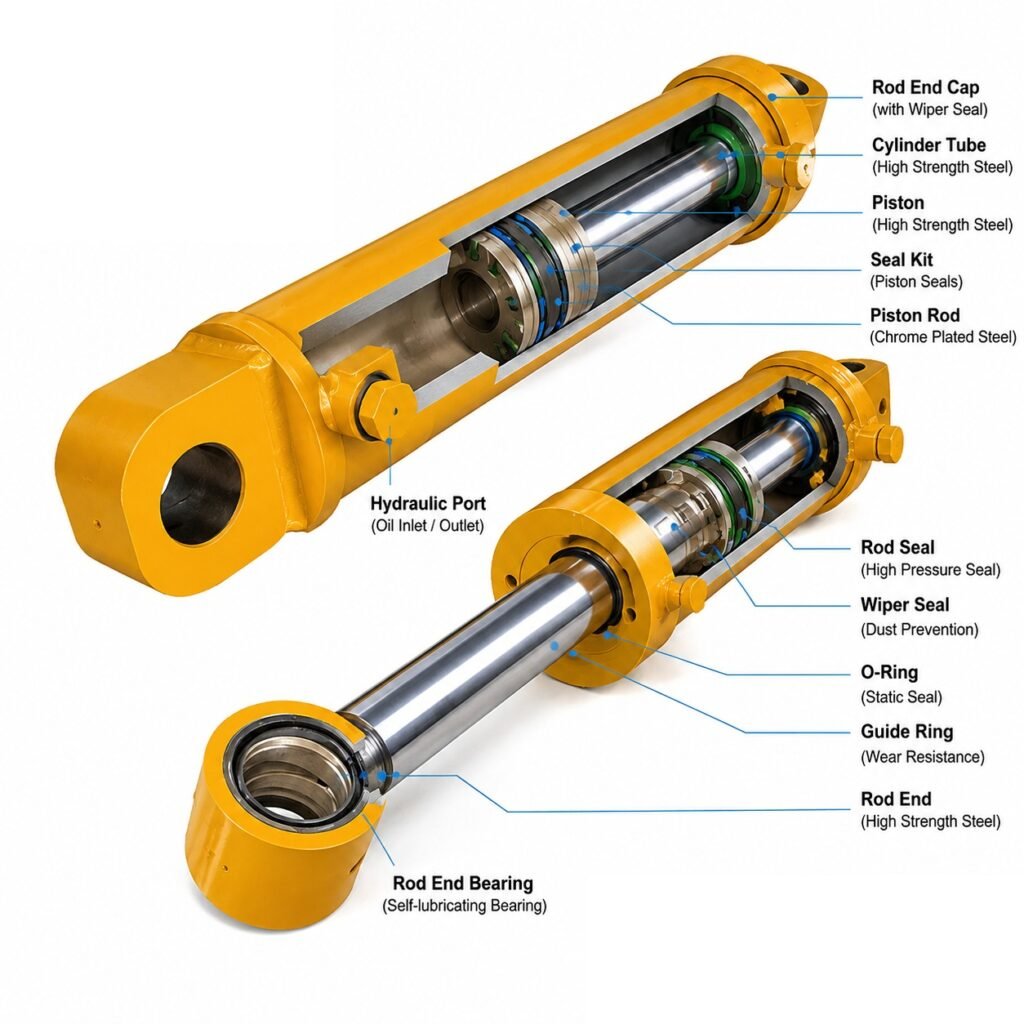
A stop tube is a rigid internal spacer, typically mounted on the piston rod inside the cylinder barrel, that physically limits how far the piston can travel toward full extension — preventing the piston from traveling to a position where the ratio of unsupported rod length to rod diameter becomes large enough to risk buckling or excessive bearing wear under side-load. Without a stop tube on a design that needs one, the piston can travel to a fully extended position where the rod’s bearing support inside the barrel is minimal relative to how far the rod extends outside it, concentrating side-load stress on the rod bearing in a way the design wasn’t intended to handle at that extreme of travel.
Why Long-Stroke Cylinders Face This Risk More Than Short-Stroke Designs
A short-stroke cylinder’s piston never travels far enough toward full extension to create a problematic unsupported rod length ratio, which is why stop tubes are rarely needed on short-stroke designs regardless of other factors. A long-stroke cylinder’s piston can travel to a position where the rod extends a long distance beyond the barrel’s bearing support, creating exactly the unsupported length condition a stop tube is designed to prevent — but the specific stroke length at which this becomes a real concern depends on rod diameter and the actual side-load the application generates, not a fixed stroke length threshold that applies universally.
Building a Framework for When a Stop Tube Is Actually Needed
| Design Factor | Stop Tube Need |
|---|---|
| Short stroke, any side-load condition | Rarely needed |
| Long stroke, minimal side-load (purely axial loading) | Less critical, but still worth calculating |
| Long stroke, meaningful side-load at extended position | Often necessary |
| Long stroke with external rod guides managing side-load | May reduce stop tube need if guides adequately control the risk |
| Very long stroke regardless of side-load magnitude | Usually necessary as a precaution against buckling risk alone |
The calculation that actually determines need compares the rod’s unsupported length at full extension against its diameter, factoring in the actual side-load the application generates — a purely axial-load application can tolerate more unsupported length than one with meaningful side-load before buckling or bearing wear becomes a real risk.
Why Skipping a Stop Tube on a Design That Needs One Produces Problems That Take Time to Surface
A cylinder missing a needed stop tube doesn’t necessarily fail immediately — the problem often shows up gradually as accelerated rod bearing wear or seal wear concentrated at full extension, since that’s the position where the unsupported rod length and resulting side-load stress are at their worst. This gradual failure pattern is part of why the stop tube decision sometimes gets overlooked during initial design: the consequence of skipping a needed stop tube doesn’t appear as an immediate functional failure, but as a shortened service life that only becomes visible after the product has already been in the field for a while.
How Adding a Stop Tube Affects the Rest of the Cylinder Design
Including a stop tube isn’t a cost-free addition — it occupies internal space within the barrel, which means the barrel may need to be slightly longer than a stop-tube-free design to achieve the same usable stroke, and the stop tube itself adds a small amount of weight and a component that needs its own design and manufacturing specification. These secondary design impacts are why a stop tube shouldn’t be added reflexively as a default precaution on every long-stroke design, but should be sized and included specifically based on the calculated need — an oversized or unnecessary stop tube adds cost and barrel length without a corresponding functional benefit.
Why Rod Diameter Selection and Stop Tube Need Are Related Decisions
A design that specifies a larger rod diameter relative to the stroke length reduces the unsupported length ratio at full extension, which can sometimes eliminate the need for a stop tube that would otherwise be necessary at a smaller rod diameter — meaning the stop tube decision and the rod diameter decision aren’t fully independent, and evaluating them together can reveal a more efficient overall design than optimizing each separately. An engineer facing a marginal stop tube need might find that a modest increase in rod diameter removes the need entirely, which could be a more cost-effective solution than adding a stop tube to a design built around a smaller rod diameter chosen for other reasons.
How External Mounting and Guiding Affect Whether an Internal Stop Tube Is Still Necessary
A cylinder design that incorporates external rod guides or additional structural support along the stroke length reduces the side-load burden on the cylinder’s own internal bearings, which can reduce or eliminate the need for an internal stop tube that would otherwise be necessary on an unguided design with the same stroke length and rod diameter. This is another reason the stop tube decision shouldn’t be made by looking at the cylinder in isolation — the complete mechanical system, including how the equipment itself supports and guides the extended rod, determines whether the cylinder’s own internal design needs a stop tube to manage the same risk.
Why Verifying the Stop Tube Decision Through Actual Load Testing Matters for Novel Designs
For a genuinely new application without a close precedent in the equipment manufacturer’s own design history, calculating the theoretical need for a stop tube is a reasonable starting point, but validating that calculation through actual load testing on a prototype — measuring real bearing wear and deflection at full extension under representative loading — provides direct confirmation that the theoretical analysis matches real-world behavior. This validation step matters most for designs operating near the boundary where a stop tube’s necessity is genuinely marginal, since a design clearly well within or well outside the risk zone needs less validation than one sitting close to the calculated threshold.
How This Decision Should Be Revisited When a Design Is Adapted for a New Application
A cylinder design originally developed for one application, with a stop tube decision made based on that application’s specific loading conditions, shouldn’t be assumed to carry the same stop tube need when adapted for a different application with a different mounting configuration or side-load profile. Re-running the unsupported length and side-load calculation whenever an existing cylinder platform gets adapted to a new application, rather than assuming the original stop tube decision still applies, catches a mismatch before it becomes a field reliability problem in the new application’s actual service conditions.
Why Stop Tube Material and Fit Deserve Their Own Attention, Not Just the Decision to Include One
Deciding that a stop tube is needed doesn’t automatically resolve every detail of its implementation — the stop tube’s material needs to handle repeated mechanical contact with the piston without generating damaging debris, and its fit on the rod needs enough precision to function as a reliable travel limiter without excessive internal clearance that lets the piston travel further than intended before contact occurs. An engineer who specifies a stop tube in principle but treats its material and fit as an afterthought risks a component that technically exists but doesn’t fully perform the function it was added to provide, which defeats the purpose of having done the original analysis to determine that a stop tube was necessary in the first place.
How Stop Tube Length Tolerance Affects the Actual Usable Stroke Delivered
A stop tube manufactured with loose length tolerance directly affects how much usable stroke the finished cylinder actually delivers, since the stop tube’s length determines exactly where the piston’s travel gets physically limited — a stop tube that’s slightly longer than specified reduces usable stroke below what the design intended, while one that’s slightly shorter allows more travel than the design calculated as safe. Specifying and verifying stop tube length tolerance with the same rigor applied to other critical cylinder dimensions matters because an imprecise stop tube can silently undermine the very safety margin the stop tube was added to provide, even though the stop tube itself appears to be present and functioning in a basic sense.
Why a Stop Tube Decision Made for a Prototype Should Be Re-Verified on Production Tooling
A stop tube validated through prototype testing, built with prototype-stage tooling and assembly methods, should be re-verified once production tooling and assembly processes are finalized, since manufacturing variation between prototype and production processes can shift the actual unsupported rod length or stop tube fit slightly from what was validated during prototype testing. Treating prototype validation as sufficient confirmation for the production design, without a final check once production tooling is locked in, risks carrying forward a validated conclusion that no longer precisely matches what’s actually being manufactured at volume — a final production-stage verification closes this gap before the design ships at scale.
Why Communicating the Stop Tube Rationale to Downstream Teams Avoids Confusion Later
A service technician or a later design engineer who encounters a stop tube inside a cylinder without understanding why it was included can sometimes treat it as an unnecessary component to be removed or modified during a repair or redesign, not realizing it was deliberately sized to manage a specific side-load risk. Documenting the stop tube’s purpose and sizing rationale somewhere accessible to service and future design teams — not just buried in an original design calculation file — prevents a well-reasoned original decision from being inadvertently undone by someone without the original context, which is a preventable loss of design intent that costs nothing to avoid through simple documentation.
Related Reading
- How Should an Equipment Manufacturer Decide Whether a Hydraulic Cylinder Needs a Position Sensor Integrated Into the Design?
- How Should an Equipment Manufacturer Decide Whether a Hydraulic Cylinder Needs Cushioning at All?
- How Does a Hydraulic Cylinder Builder Decide What Rod End Configuration to Specify on New Chrome Plated Rod?
Discuss Stop Tube Requirements for a Long-Stroke Cylinder Design
Designing a long-stroke cylinder and need help calculating whether a stop tube is actually required for your rod diameter and loading condition? Contact our team to review your specific design parameters.
What We Offer
- Technical calculation support for unsupported rod length and stop tube sizing
- Design input on balancing rod diameter and stop tube requirements for cost-effective long-stroke designs
- Prototype and load testing support to validate marginal stop tube decisions
- Honed tube and chrome plated rod specification support matched to your complete cylinder design
Contact EAST AI (eastai-tech.com) Email: marketdi@east-ai.cn Phone: +86 13382202696 Address: No. 108, Lunan Road, Wuxi, Jiangsu, China.
Written by Alex, Production Engineer at EAST AI