
Written by Alex, Production Engineer at EAST AI
Salt spray hours are one of the most quoted and least understood numbers in the chrome plated rod business. A customer will tell us a competitor promises a rod that survives a certain number of hours of neutral salt spray, as though that single figure settles the question of corrosion resistance, and they want to know whether we can match it. The honest answer is that salt spray testing is genuinely useful when you understand what it measures and what it does not, and genuinely misleading when it is treated as a simple bigger-is-better score, so it is worth explaining properly.
Unlike honed tube, where corrosion resistance is a matter of material selection and storage protection rather than coating performance, the chrome plated rod is exactly the product where salt spray testing belongs, because it is the chrome coating whose corrosion resistance the test evaluates. That distinction matters, and it is where a lot of confusion starts. For chrome rods, salt spray testing is a legitimate and standardized way to compare coating corrosion resistance, provided everyone involved reads the results with the right understanding of the method’s strengths and limits.
What the Test Actually Does
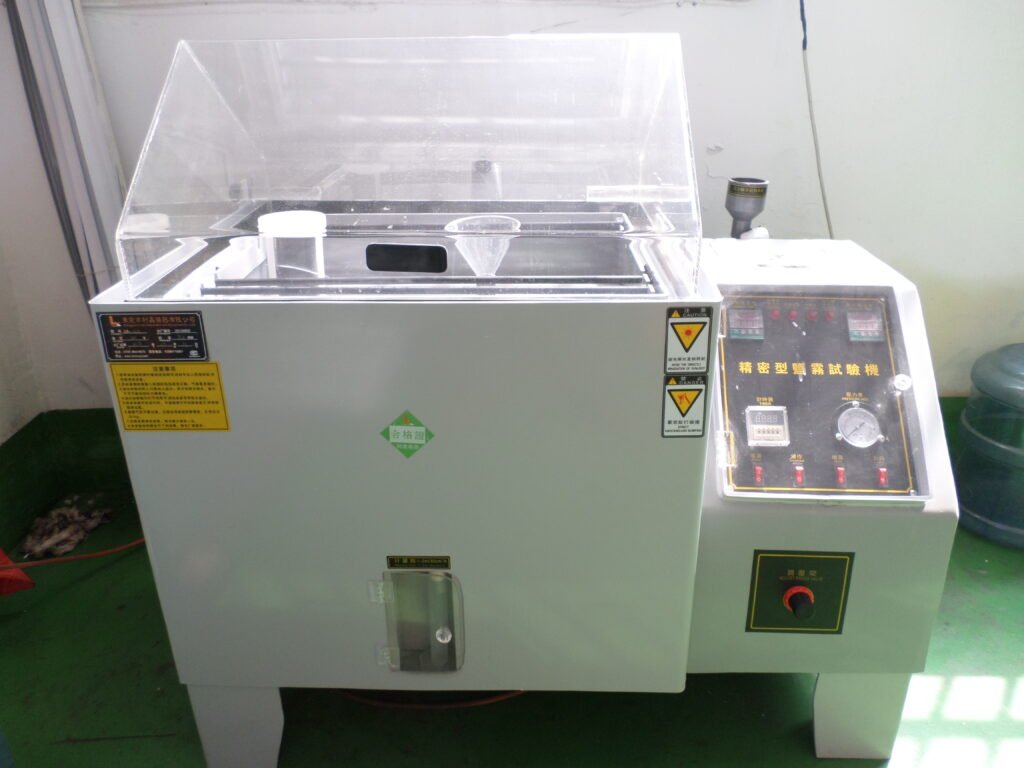
Neutral salt spray testing, standardized under methods such as ASTM B117 and its ISO equivalent, exposes the plated rod to a continuous fine mist of salt solution inside a controlled chamber at an elevated temperature. The rod sits in this aggressive, constant, salt-laden environment, and technicians periodically inspect the surface for the first appearance of corrosion, recording the number of hours until corrosion products appear. The result is expressed as hours to first corrosion, and a higher number indicates that the coating resisted the salt fog environment for longer before failing.
The value of the test is that it is standardized and repeatable, which makes it a fair basis for comparing coatings under identical conditions. Because the chamber conditions are tightly controlled, two rods tested the same way can be meaningfully ranked against each other, and the test can verify that a coating meets a specified corrosion-resistance requirement. For a chrome plated rod, whose whole job includes protecting the base steel from corrosion, that ability to verify and compare is genuinely useful, and it is why the test is written into so many specifications.

Why More Hours Is Not Always the Whole Story
The trap in salt spray testing is treating the hours figure as a direct, linear measure of how long a rod will last in the real world, because it is not. The salt fog chamber is a deliberately accelerated and artificial environment that does not reproduce the specific combination of wetting and drying cycles, temperature swings, abrasion, mechanical loading, and actual media that a rod encounters in service. A rod that survives many hours in the chamber will generally resist corrosion well, but the hours do not convert into a guaranteed number of years in any particular application.
This matters because two rods with the same salt spray rating can still perform differently in service if their duty cycles differ, and because a rod’s real environment includes abrasion and mechanical wear that the static salt spray test does not apply. A rod might have excellent salt spray numbers yet wear through its chrome quickly in an abrasive application, because the test measured corrosion resistance and not wear resistance. Reading the number correctly means understanding that it ranks corrosion resistance under one standardized condition, not overall rod durability across every real-world stress.
What Drives the Salt Spray Result
The salt spray performance of a chrome plated rod is driven largely by the nature and thickness of the coating, which is why the test result and the coating specification are so closely linked. Hard chrome inherently contains a fine microcrack network from the electroplating process, and corrosive salt fog eventually works through that network to reach the base steel, so a thicker chrome layer, which lengthens and complicates that path, tends to deliver better salt spray performance. This is the same thickness logic that governs corrosion resistance in the field, expressed through the standardized test.
For applications that demand the highest corrosion resistance, an enhanced coating system such as a nickel-chrome duplex layer changes the salt spray result dramatically, because the nickel underlayer provides a barrier that single-layer chrome cannot. A duplex-coated rod will typically post far higher salt spray hours than a plain hard-chrome rod of similar thickness, which is exactly why marine and offshore specifications so often call for it. Understanding that the coating system, not just the hours target, is what actually delivers the corrosion resistance is the key to specifying sensibly rather than chasing a number.
Using Salt Spray Data Honestly
The right way to use salt spray data is as one input into a corrosion-resistance decision, matched to the real environment the rod will face, rather than as a headline figure to win or lose an order. If the application is genuinely corrosive, such as coastal, marine, or chemically aggressive duty, then a meaningful salt spray requirement backed by an appropriate coating system is entirely appropriate and worth paying for. If the application is a clean, dry, indoor environment, then a demanding salt spray specification is largely irrelevant, and requiring it adds cost without adding value.
We are comfortable providing salt spray test data and meeting specified requirements, and equally comfortable telling a customer when a high salt spray target is the wrong thing to be optimizing for their actual environment. The goal is a rod whose corrosion resistance matches its duty, verified by a test everyone understands, rather than a rod chosen to top a leaderboard that may not reflect its real service conditions. That honest use of the data is what turns salt spray testing from a marketing number back into the engineering tool it was designed to be.
Matching the Test to the Specification
The cleanest specifications tie the salt spray requirement to the coating system and the environment together, so the number, the coating, and the duty all make sense as a package. A coastal rod specified with a duplex coating and a correspondingly high salt spray requirement is coherent, because each element supports the others and reflects the real corrosion threat. A rod specified with an aggressive salt spray target but a thin single-layer coating and a benign indoor environment is incoherent, because the pieces do not fit together and the number is not doing any real work.
This is where diameter tolerance and finishing also enter the picture, because the coating has to be applied and then ground back to the finished diameter within the specified tolerance grade, and that finishing affects the final surface the test evaluates. A rod specified to a defined ISO tolerance grade with a matched coating system and a sensible salt spray requirement is a complete, buildable specification, and that is what we work toward with customers. Getting all three aligned before production is how a chrome plated rod ends up genuinely fit for its environment rather than merely well-tested against a standard that may not match it.

Related Reading
- Chrome Plated Rod for Offshore and Marine Deck Equipment: Corrosion Resistance Beyond Standard Chrome Plating
- Chrome Plated Rod Diameter Tolerance: f7 vs f8 vs g6 — How to Choose the Right Fit
- Chrome Plated Rod for Truck-Mounted and Crawler Cranes: Long-Stroke Straightness and Bending Resistance
External Reference
- ISO 286-1 — ISO code system for tolerances on linear sizes (basis for the ISO rod tolerance grades referenced above): https://www.iso.org/standard/45975.html

Specify Corrosion Resistance That Matches Your Environment
A high salt spray number on a rod headed for a clean indoor press is wasted money, and a low one on a rod headed for the coast is a failure waiting to happen; the number only means something when it matches the duty. At EAST AI we provide salt spray test data, meet specified corrosion requirements, and match the coating system to your real environment, because a rod’s corrosion resistance should be engineered to where it works, not to win a specification comparison on paper.
What We Offer
- Neutral salt spray (NSS) test data and verification against your specified requirements
- Hard chrome and nickel-chrome duplex coatings matched to real corrosion environments
- Controlled coating thickness ground to defined ISO diameter tolerance grades
- Honest guidance on when high salt spray targets add value and when they do not